
Tết
On Pigs

How can Tết be completed without the traditional thịt kho? Tết or Tết Nguyên Đán is the Vietnamese Lunar New Year that is a few days away. It‘ll be the Year of the Horse and the fourth year since I stopped eating this mouthwatering and deeply umami thịt kho, a Vietnamese braised pork and eggs dish.
Thịt kho, the quintessential dish in the Vietnamese daily meal, symbolizes the coming together as family. Naturally, the dish is also one of the important dishes to share with family on this special occasion. During Tết, my mom would complete all the cooking before New Year’s Day, so that the during the first three days of the year, the family could enjoy time together, visiting extended family and friends or receiving guests without having to worry about cooking. This tradition is widely practiced by most Vietnamese families in various part of the world.
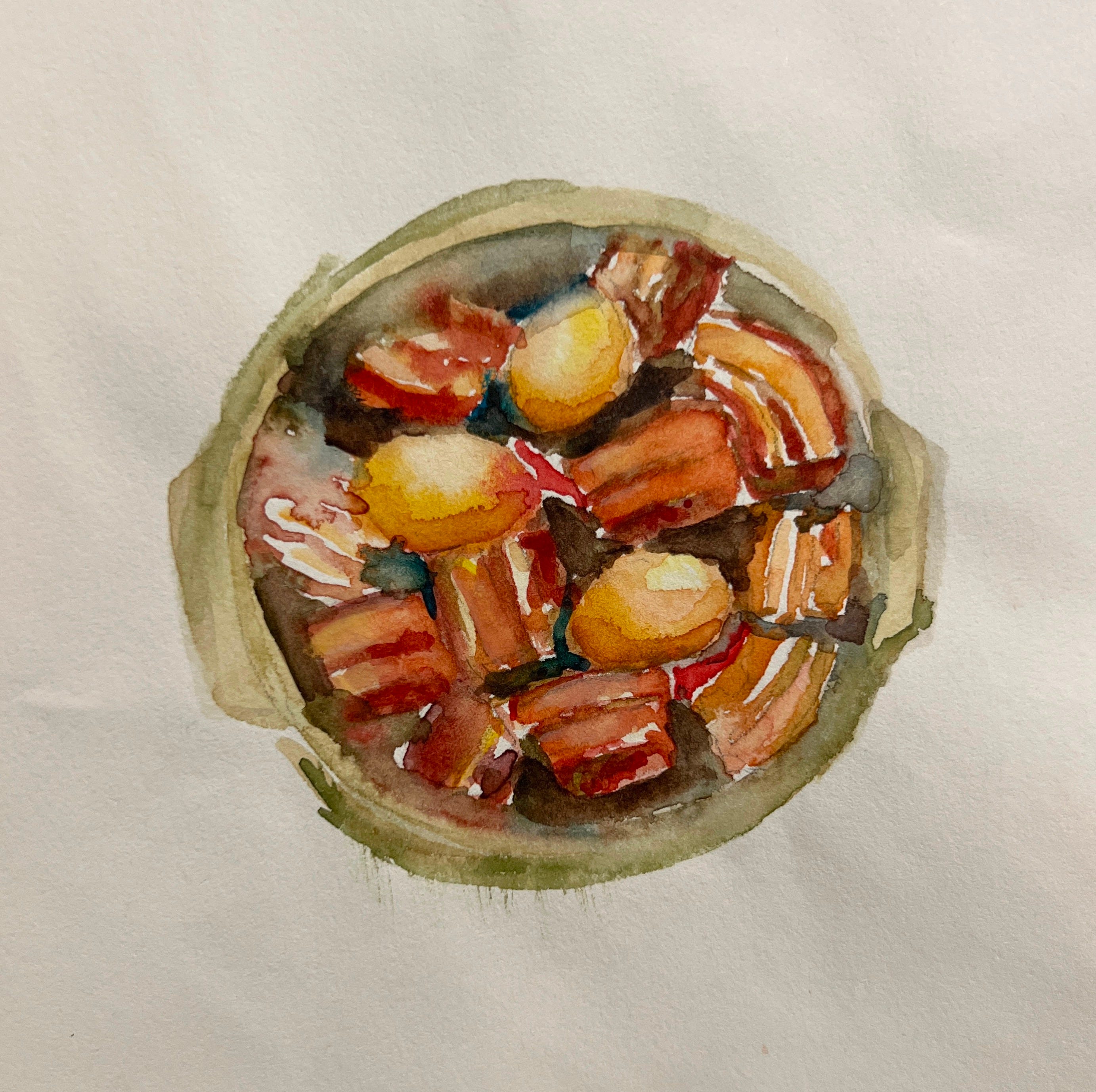
The best cut to make this dish is pork belly, one of the cuts used to make bacon. Other ingredients needed to make the dish are eggs, fish sauce, sugar, water, salt, and lots of freshly ground black pepper. Optional ingredients are shallot and coconut juice or soda instead of water. When I just started making this dish decades ago, I would employ the simpler process by making caramel sauce using sugar first then adding the thick cut pieces of pork belly and cook for a few minutes on each side so it would soak in the gorgeous caramel color before adding the rest of the ingredients. I would add the coconut water and fish sauce slowly to keep the sauce thick and to keep the sugar from crystalizing. The meat would be simmered for about 10 minutes to soak in all ingredients and sauces before adding the hard-boiled eggs. I would add more fish sauce to taste and coconut water as necessary for braising until tender.
As I learned to refine the dish, I later would sear the pork with vegetable oil, minced shallot and garlic, and salt and black pepper on high heat first to create a crust before adding it to the freshly made caramel sauce. The searing would also lock in the juices enhancing the taste and the esthetic with the crispy exterior packed with favor. Who can resist the caramelized and juicy bite of thịt kho accompanied by the sweet and savory sauce drizzled over white rice? And the eggs! OMG, the eggs were to die for, and I used to save them for last. It was like having your best treat after eating all of your favorite treats. It would be a glorious day to share a meal with family and friends that included a well-made dish of thịt kho.
Sharing a meal with family has not been the same since I became vegan and the transition was not easy. Though I believe in my decision, it was challenging to fully participate in family gatherings or cultural celebrations. I wanted to share the same dish with each of my family members. I didn’t want to be a buzzkill at the table. The desire to fit in and not draw attention to myself was often at odds with the decision to be more compassionate towards my fellow non-human beings. I also was avoiding questions since I wasn’t able to articulate my reasons to no longer harm a non-human animal then. Watching my family having a family meal, I could still taste the flavor of the beloved traditional dish. There was a sense of sadness and loneliness at the dining table while being surrounded by loved ones. I mostly stayed quiet or engaged superficially while working through the emotional turbulence inside.
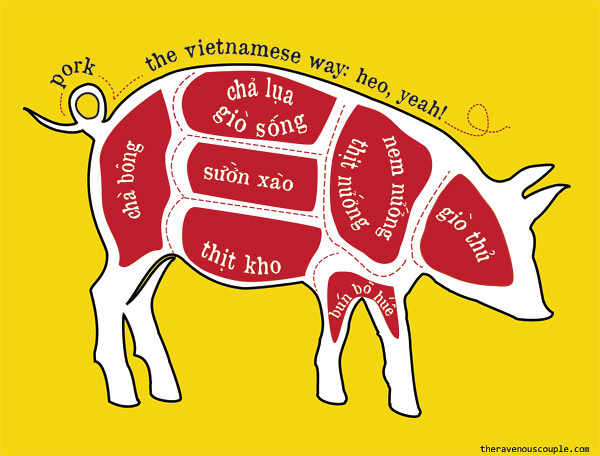
I didn’t know much about pigs growing up, but since it was relatively inexpensive raising pigs, the meat was more affordable compared to other protein sources, so pig flesh was used for many dishes in Vietnamese cooking. There’s even a pork cut diagram for some of the major Vietnamese dishes.
I remembered pigs were raised in small numbers by giving them cheap food and household food waste, and they lived closely with the owner. When I was growing up in Saigon, Vietnam, our family would store food waste in a small bin to be picked up every few days by a lady who raised pigs. She would come into the small alley in the back of our house and announced loudly “ cơm heo đây” or rice for pigs is here so that households in the neighborhood would put their bin of food waste outside of their house for her. She would pour them evenly into two big pots sitting in the wicker baskets at the two ends of her “đòn gánh” that she then carried away by balancing the pots via the bamboo pole on her shoulder. This practice of collecting food waste was an informal way of reducing waste from landfills and turned it into useful resource to feed pigs.
Some farms raised pigs in large spaces. However, to meet the increasing demand in the growing population, modern-day pigs are raised by up to thousands in commercial farms, and even in climate control buildings. They’re typically confined in a small space that only allows for standing or laying straight without being able to turn around and without the ability to express their natural behaviors as highly sociable and intelligent beings. Of course I didn’t know this then. I remembered one of the common sayings in Vietnamese was “ngu như heo” or stupid like a pig. The sayings were used a lot casually or as a joke demonstrating how misunderstood pigs were. I had used the saying with the siblings when teasing each other. What was used towards me would be an insult to my friend, pigs.
In 2015, WellBeing International Studies Repository published an article entitled “Thinking Pigs: A Comparative Review of Cognition, Emotion, and Personality in Sus domesticus.”1 The authors wrote: “In this paper we have identified a number of findings from studies of pig cognition, emotion, and behavior which suggest that pigs possess complex ethological traits similar, but not identical, to dogs and chimpanzees,” such as self-awareness, memories, personalities, emotions and using tools. The authors also suggested 11 other research areas relating to cognition in pigs and listed over 160 references for the paper and called for additional research in a more natural setting (non-laboratory) to enable the pigs to “express their natural abilities.”
There’s so much information available to support just one article for one non-human animal that should be distributed widely; however, we won’t be that lucky to see them. This would crumble the poultry industry that they have worked so hard to conceal us from seeing the cruelty of pig farming, slaughterhouses, and treatment of this incredible being. Plus, are we ready to give up the tasty bacon in our breakfast with eggs and sausages, and the tender pulled pork that would melt away in the first bite?
When I see bacon, I see a pig, I see a little friend, and that’s why I can’t eat it. Simple as that. --Paul McCartney
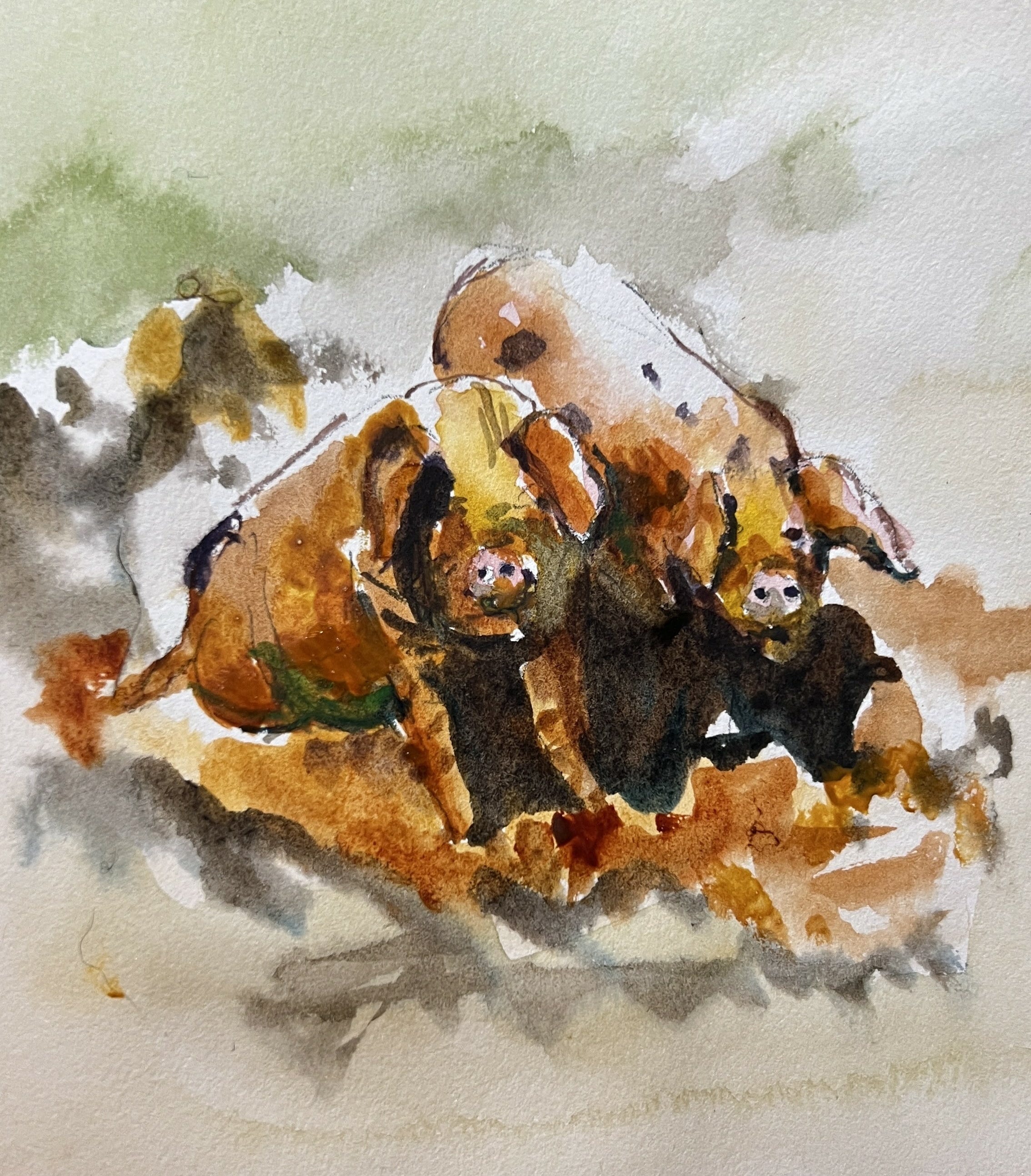
Before all of the statistics and research data became widely available, many people had observed the human animal-like personality in non-human animals as well as the cruelty committed towards them. In professor Shelley Fisher Fishklin’s book, “Mark Twain’s Book of Animals,” she considered Mark Twain one of America’s early prominent animal advocates. Her book includes Mark Twain’s selected published and unpublished writings about animals spanning over 50 years 1850-1910. Observing and writing about animals was how Mark Twain developed his dreary view of humankind: “Malice resides in no animal but one – Man.” Though I don’t disagree with Twain, I felt terrible reading this because sadly, I’m in the ‘Man’ category.
In an 1867 article for San Francisco Daily Alta California under the title “Cruelty to Animals”, Mark Twain described the works of the Society for the Prevention of Cruelty to Animals in New York City and highlighted an event where he followed the founder, Hendry Bergh, to make a case with the Wallack’s theatre manager to alter the Griffith Gaunt play to release the pig from a shows.
Mr. Bergh – Why, it is plain enough. They punch the pig with sticks, and chase him and harass him, and contrive all manner of means to make him unhappy. The poor thing runs about in its distress, and tries to escape, but is met at every turn by its tormentors and its hope blighted. The pig does not understand it… the pig does not know it is a play, but takes it all as reality, and is frightened and bewildered by the crowd of people and the glare of the lights, and yet no time is given it for reflections… And besides, the pig is cast in the play without its consent, is forced to conduct itself in a manner which cannot but be humiliating to it, and leaves that stage every night with a conviction that it would rather die than take a character in a theatrical performance again.
Manager – Say no more, sir. The pig is yours… so I present him to you, who will treat him well, I am amply satisfied.
If Mark Twain’s observations and advocacy against animal cruelty have been around since 1800, why are people who decide to go vegan for the animals often ridiculed, mocked, or judged for their compassion? I wish people would be curious about each other a bit more before drawing conclusions, or I can just go with what the comedian Preacher Lawson said: “I decided to go vegan… I was sitting around one day, and I thought to myself, I was like, man, I just got way too many friends, and how do I fix this? And so, I decided and it worked. No one wants to go out to eat no more. They hate you and stuff.” I also loved how Julio Torres tackled veganism: “People asked me if I missed meat or dairy. I mean I missed being liked.”
Another common saying was “dơ như heo” – dirty like pigs. My friends, pigs were misunderstood again. My parents had used this expression a few times when they tried to get us kids to clean up. They would compare our dirty room to a pig pen. Just because people traditionally mistreat pigs, not given them a clean place or wash them, or pigs are often observed to be rolling around in mud in their natural habitat, doesn’t mean they’re dirty. I know now that pigs are similar to human animals in a way that they get sunburned. Pigs are sociable and playful, so by rolling in sand and mud to create a protective lay for their skin from the sun, insect bites and to regulate their temperature while bonding with each other. We have been so unfair to pigs. OK I was unfair to them as well. In the natural environment, they’re one of the cleanest animals. With sufficient amount of space, pigs prefer to keep their eating, sleeping and relieve areas separated, a trait similar to many other nonhuman animals including dogs. They also like to decorate their sleeping space by bringing hay and flowers to them. I work hard on cutting down my time scrolling on Instagram, but I can’t resist watching pigs making happy sounds while carrying hay back to their pen, or a mother pig bringing toys to her young.
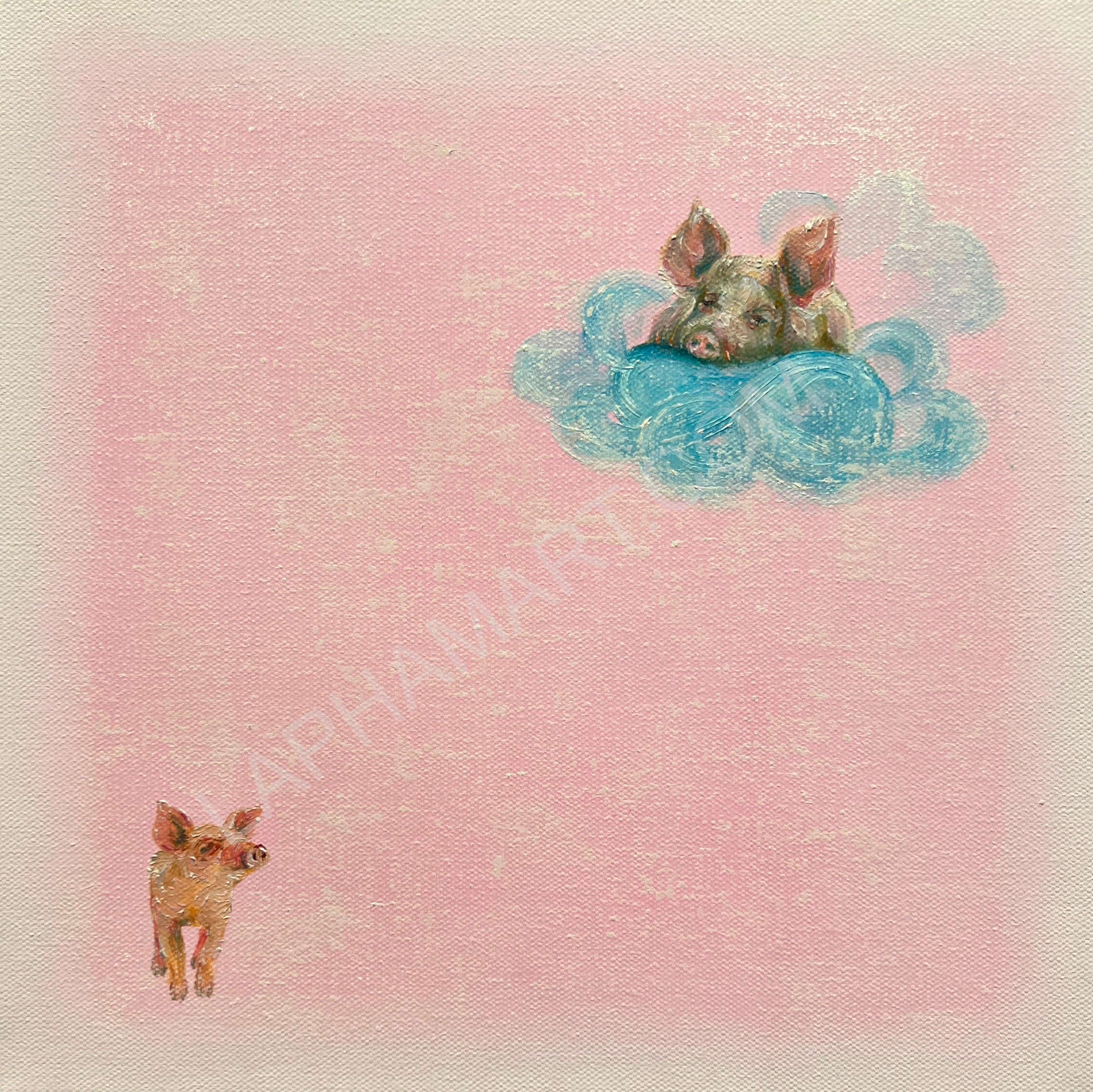
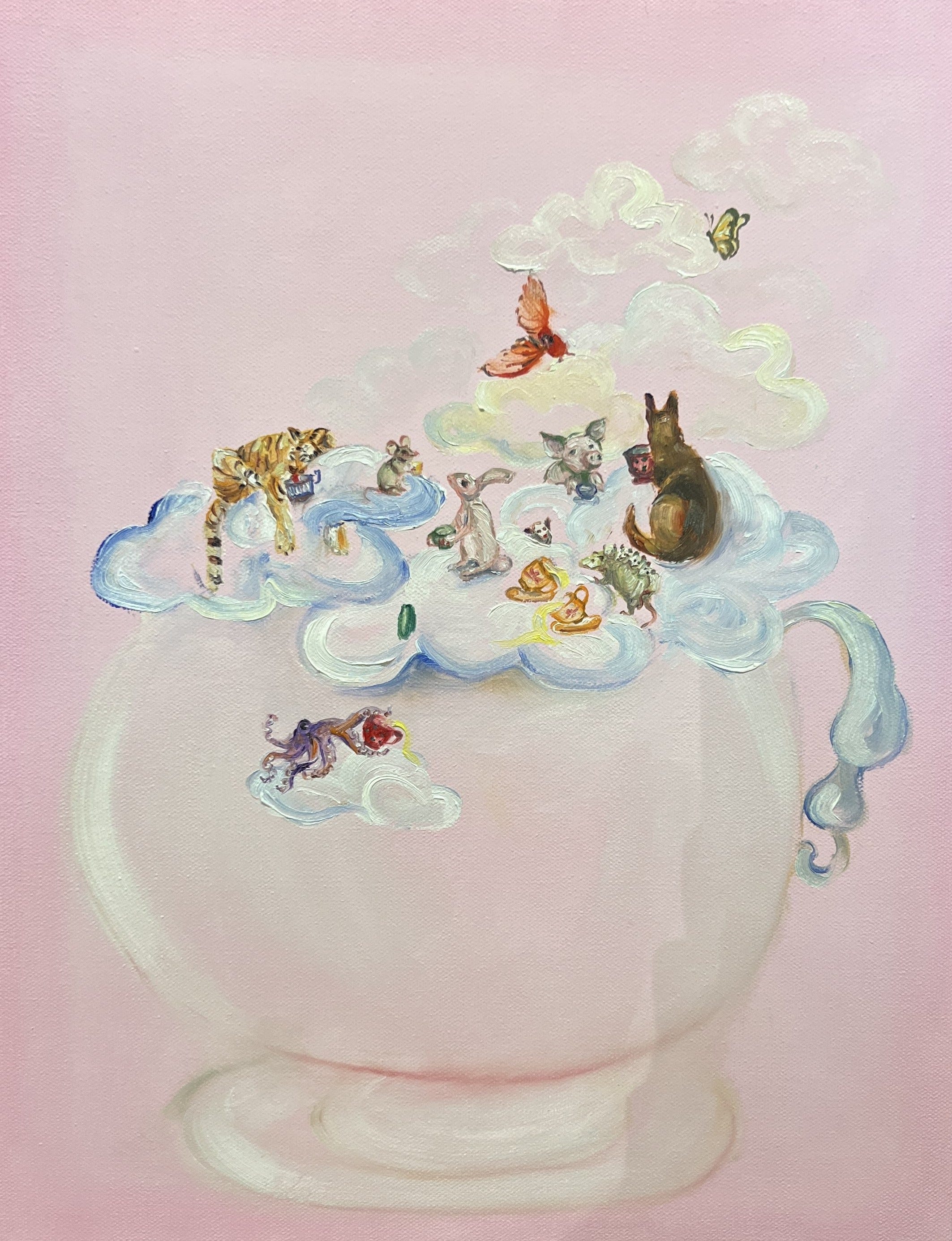
I recently started working on painting a scene of non-human animals having tea in heaven for an exhibition application, an extension of #allanimalsgotoheaven collection to honor the innocent lives regardless of their experience on this earth. I did a quick pencil sketch then started painting on canvas. The final look often ended up a bit different from the initial sketch as I adjusted the composition during the painting process as well as allowing my intuition and the studio ghost to guide me. I initially sketched Ahsoka, my free model/fur baby – a German shepherd, facing away from me having tea with the tiger on the left, but decided to move Ahsoka to the right with her red teacup. I then placed a pig facing Ahsoka with her little blue teacup. I realized my subconscious worked its magic, Ahsoka and Pig are having conversation, a conversation the vegan community often imagined on how one animal is treated differently, one is a beloved family member while one is food.
Pig: What are you having Ahsoka?
Ahsoka: Matcha latte, my mom used to make this every morning.
Pig: I wish I had a mom while on earth. Your mom was so proud of you, Ahsoka. And you are so smart.
Ahsoka: I wish you did you, too. You’re very kind and intelligent, Pig. You would love living with us. What are you drinking?
Pig: Just black coffee. Never thought I would be tasty. Ah, and I would also like to have a name.
Ahsoka: Mom and Dad would give you a beautiful one and lots of kisses.
Pig: Thank you, Ahsoka. I like to try earth again - with you.
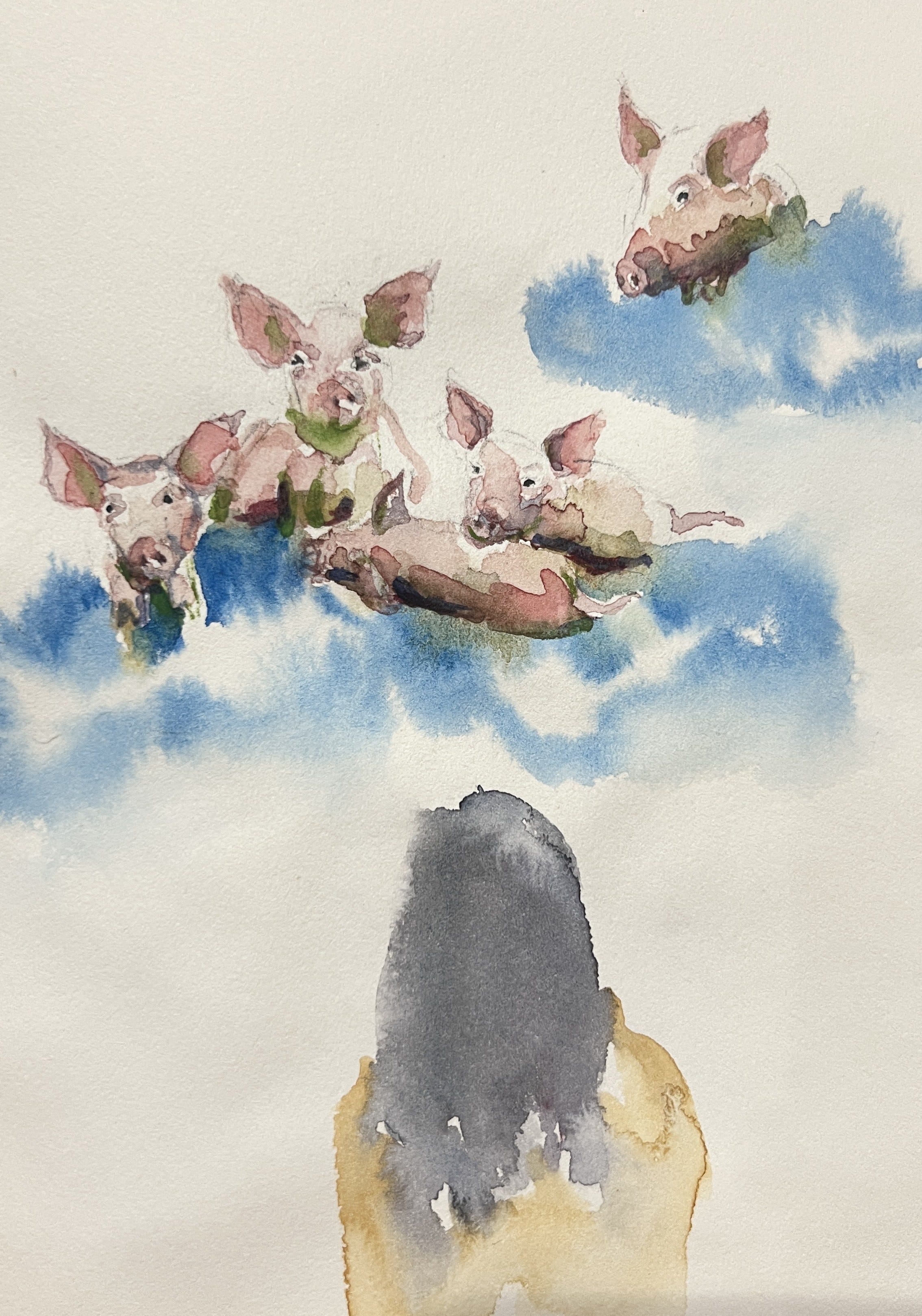
I stopped eating meat [in the 60’s] when I looked at the pork chop on my plate and thought: this represents fear, pain, death. That did it, and I went plant-based instantly.-- Jane Goodall
One common saying that I agree with is “ngủ như heo” - sleep like pigs. Ok, this is not a misunderstanding, it’s the truth. I’m a light sleeper so I would welcome the opportunity to ngủ như heo from time to time. Pigs seem to sleep through anything. In my recent visit to the Polar Spring Animal Sanctuary in Poolesville, Maryland, for a cruelty-free Thanksgiving potluck with about a thousand people bringing vegan dishes to share, I witnessed pigs sleeping through the noises of visitors walking around and kids petting them. One particular pig didn’t move while two little girls rubbing his belly for a good 15 minutes. He probably had floated to heaven and dreamed about eating all of the delicious treats at the time. Who wouldn’t want to lie next to him and dream a happy dream? I wanted to sleep next to him.
As I learned more about the nonhuman animal world and appreciate the fact that they are more willing to share this earth with us, the human animals. I became more confident with my choice and often wish I were more informed and had gone vegan much earlier.
Well, to celebrate this new year, I’m going to think of pigs while cleaning and decorating my house and having thịt kho [without eggs] at Chay restaurant. I’ll indulge in some good sleep and dream about having a lighthearted conversation with my pig friends from heaven. Would they be offended if I eat fake pig flesh even though it’s fake?
Pigs: So, you missed eating us?
Me: But it’s fake meat and Chay does it very well. It’s tasty.
Pigs looking at me with pity
Me: C’mon, I’ve done well by you. Let me live a little?
Pigs: A bit pathetic don’t you think? But go on, enjoy your new year.
Me… embarrassed
1. Thinking Pigs: A Comparative Review of Cognition, Emotion, and Personality in Sus domesticus from Well Being International Studies Repository by Lori Marino, The Kimmela Center for Animal Advocacy and Christina M. Colvin Emory University
Thinking Pigs: A Comparative Review of Cognition, Emotion, and Personality in Sus domesticus
Or https://www.wellbeingintlstudiesrepository.org/cgi/viewcontent.cgi?article=1042&context=acwp_asie
You've raised my consciousness in an empathetic and meaningful way--not just about nonhuman animals but also about vegans in different cultures. Love how your paintings deepen the message. Brava, Ann!
Brilliant, heartfelt story intertwined with memories, culture, and fantastical heavenly "non-human animals." I am embarrassed and saddened by humans (and my own) desire to look away from the pain inflicted on innocent animals for our pleasure. It's a paradox that we treat our dogs and cats like our children, but a pig is deemed dirty and stupid -- therefore it is permissible to enjoy them for breakfast. I can't help but rethink my menu choices. And, I'm not ashamed to say that I wouldn't think twice about slumbering next to a pig, like Ann, if Mr. or Ms. Pig accepted my offering of fresh hay and, of course, flowers.